BREAST PROCEDURE GUIDE · NORTH ALABAMA
Inverted Nipple Correction in Decatur, Alabama
Explore correction options, breastfeeding considerations, a historical before-and-after photo, and what to ask about recovery and costs.
Inverted nipple correction aims to bring an inward-facing nipple above the surrounding areola. Before considering surgery, establish whether the inversion is longstanding or a new change that needs medical evaluation. [1][2]
This guide explains the questions to discuss when considering inverted nipple surgery in Decatur, AL. It includes an original historical comparison and practical planning information for consultations in Decatur, Huntsville, or nearby North Alabama communities.
ON THIS PAGE
- Understanding nipple inversion
- When a change needs assessment
- Correction options
- Breastfeeding considerations
- Historical before-and-after photo
- Surgery and anesthesia
- Consultation and preparation
- Recovery and time off work
- Scars, recurrence, and other risks
- Costs and insurance
- Choosing a local surgeon
- Consultation checklist
- Common questions
Understanding nipple inversion
An inverted nipple sits below the surface of the areola, the darker skin surrounding it. Inversion can affect one side or both. Shortened milk ducts and fibrous tissue can contribute to a longstanding inward pull. [1]
Some nipples come outward readily, others retract again, and some remain deeply inverted. Examination helps determine severity and treatment options. [1]
Describe what concerns you most, whether it is appearance, irritation, a change from your usual nipple shape, or feeding difficulty. These concerns can call for different assessments; the goal of a consultation is to identify the problem before choosing a procedure.
When a nipple change needs medical assessment
A nipple that has recently turned inward should be checked before cosmetic treatment. Tell your clinician about a lump, discharge that is not breast milk, skin dimpling, scaling, or a change in breast shape. Most breast changes are not cancer, but an examination is needed to determine the cause. [2]
Depending on the findings, a clinician may recommend diagnostic breast imaging or other tests. A recent normal screening mammogram does not mean a new nipple or breast change can be ignored. [2]
When booking, explain that the inversion is new if that is the case. Ask whether you should start with your primary care clinician or a breast specialist before arranging a cosmetic surgery consultation.
Correction options
Observation and feeding support
If your main concern is breastfeeding, nipple shape alone does not establish that surgery is needed. Babies take in breast tissue as well as the nipple, and many people with flat or inverted nipples can breastfeed. A lactation professional can assess positioning, attachment, and milk transfer. [5]
Commercial nipple everters, shells, or shields should be discussed with a trained lactation professional rather than treated as a guaranteed correction. Feeding support and a lasting change in nipple projection are different goals. [5]
Surgical correction
Surgery releases tissue holding the nipple inward and supports its outward position. Techniques may preserve the milk ducts or divide them; sutures or small tissue flaps may provide support. Ask which method is proposed and how it affects future breastfeeding. [1]
A useful treatment plan should explain whether one or both sides need correction, the intended projection, the incision location, and what symmetry is realistic. Request healed examples from the same technique, including any visible scars.
Breastfeeding considerations
Discuss future breastfeeding before agreeing to surgery. Milk ducts can be damaged or cut during correction, so a more prominent nipple does not necessarily mean better feeding function afterward. Ask the surgeon explicitly whether the planned operation preserves the ducts. [4]
Duct preservation is an important aim, but it is not a guarantee of successful breastfeeding. Research on feeding outcomes after correction involves relatively small groups. Make your priorities clear when comparing techniques or discussing whether to defer surgery. [1]
If you are pregnant, currently breastfeeding, or hoping to breastfeed later, include that information at the first visit. For current feeding difficulties, seek help early rather than waiting for a surgical consultation. A lactation professional can help assess your baby’s attachment and whether feeding is effective. [5]
Historical inverted nipple correction before-and-after photo
The original image labels the left photograph “Before Correction” and the right photograph “After Correction At 18 Months.” That specific image caption is retained here. The operative details and timing have not been independently verified.
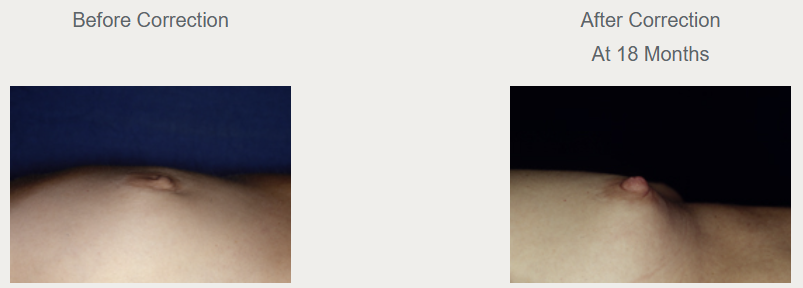
This is an individual result from the former practice, not a prediction of your outcome or evidence of services currently offered by this website. A photograph cannot show nipple sensation, breastfeeding function, or the risk of recurrence.
Surgery and anesthesia
Inverted nipple surgery is often performed as a day procedure under local or general anesthesia. The choice depends on the planned correction and your circumstances. The surgeon releases the inward pull and uses stitches to support the nipple; a protective dressing or splint may be applied. [3]
Confirm where the operation will take place, who will provide anesthesia, and whether you can go home the same day. The original article’s named hospital, one-hour operating time, and discharge schedule describe former arrangements and should not be treated as a current care plan.
Ask whether the correction is being planned by itself or with another operation. Our breast lift guide and breast augmentation guide discuss related procedures; have the surgeon explain how any combined plan would affect your recovery and goals.
Consultation and preparation
At the consultation, explain when the inversion began, whether it has changed, and any related symptoms or previous breast procedures. The clinician should review your history, examine the area, and discuss whether further testing is needed. [4]
Bring your medicines and supplements list and explain your pregnancy or breastfeeding plans. Ask for written instructions covering medicines, fasting if applicable, transport, dressings, and follow-up. Have the surgical team coordinate any medication changes with the prescribing clinician.
Before leaving, make sure you know what the protective dressing will look like, how it will fit under clothing, and who to contact if it becomes displaced. Arrange transport home and ask what help you may need during the first day.
Recovery and time off work
Some swelling, bruising, or discomfort can follow correction. Many patients return to light work within a few days, but strenuous activity needs a longer pause. Nuffield Health advises avoiding strenuous activity for at least a week; your surgeon may set different restrictions. [3]
Protecting the nipple
Protect the area from pressure and rubbing while it heals. Ask which bras and tops are suitable and when normal clothing can be resumed. A protruding protective dressing may affect comfort and work clothing even when pain is manageable. [3]
Follow the specific dressing and bathing instructions you receive. Do not remove stitches yourself or apply creams to the incision unless directed. General wound-care instructions do not replace the plan for a nipple splint or special dressing. [6]
Follow-up and activity
Before discharge, confirm the first follow-up appointment and any later stitch or dressing removal. Ask separately about driving, lifting, exercise, and activities that put pressure on the chest. Your surgeon should explain when those activities are appropriate. [4]
The original page used fixed visits at five and ten days. Current follow-up should reflect the actual technique, dressing, and healing progress. For a physical job, describe your duties and ask whether temporary modifications would help you return safely.
Scars, recurrence, and other risks
Potential problems include infection, pain, scarring, asymmetry, damage to milk ducts, and renewed inversion. Ask how these risks apply to the proposed method and your health. [3]
Altered sensation, wound breakdown, and nipple tissue loss have also been reported. A surgical review found variable outcomes without establishing one best technique. [1]
The aim is lasting projection with an acceptable scar, but neither perfect symmetry nor a permanent correction can be promised. Ask how recurrence would be assessed, whether another procedure could help, and what additional treatment would cost.
When to contact the surgical team
Contact the team promptly for increasing redness, pain, swelling, bleeding, foul-smelling drainage, fever, or a wound that opens or looks dark. Follow any additional warning instructions provided for the nipple and its dressing; do not wait for a routine visit if you are concerned. [6]
Inverted nipple correction costs and insurance
Request an itemized quote for the operation you are considering in Decatur or the surrounding area. Ask whether it covers one nipple or both, the surgeon, facility, anesthesia, dressings, follow-up, and treatment of complications or recurrence.
The former article described its correction procedure as not covered by insurance. That historical statement does not determine coverage under your current plan. Ask the insurer whether your diagnosis and proposed treatment are covered, whether authorization is required, and what you would owe.
Distinguish the assessment of a new nipple change from an elective appearance-focused correction when discussing billing. Ask for the expected costs of the consultation and any diagnostic testing as well as the procedure.
Choosing a surgeon near Decatur
When comparing options in Decatur, Huntsville, Athens, or nearby communities, verify the physician’s license through the Alabama Board of Medical Examiners. For a plastic surgeon, check specialty certification separately using the American Board of Plastic Surgery verification tool. [7][8]
Ask how often the surgeon performs inverted nipple correction, which techniques they use, and how they discuss duct preservation and recurrence. Confirm the facility, anesthesia arrangements, follow-up access, and who will help if a problem develops after hours.
Common questions
Does nipple inversion always mean cancer?
No. Many nipple variations are longstanding, and most breast changes are not cancer. A new change still deserves medical assessment, particularly with a lump, discharge, or skin changes. [2]
Is general anesthesia always necessary?
No. Local or general anesthesia may be used. Ask which is proposed for your operation and why. [4]
Can an inverted nipple come back after surgery?
Yes. Recurrence is a recognized risk. Discuss the surgeon’s experience with your proposed technique and the options if the nipple retracts again. [3]
Does an inverted nipple prevent breastfeeding?
Not necessarily. A baby latches onto breast tissue as well as the nipple. Seek skilled feeding support if attachment is difficult, and discuss feeding plans before any corrective operation. [5]
Sources and further reading
Resources checked September 22, 2026. This guide updates the supplied historical inverted nipple article and preserves its complete comparison image. The image’s 18-month caption is used instead of the former page’s general 12-month heading. Historical hospital arrangements and recovery schedules are not presented as current services. This page has not been reviewed by a clinician on behalf of this website.
- Mangialardi ML and colleagues. Surgical Correction of Inverted Nipples. Plastic and Reconstructive Surgery Global Open, 2020.
- National Cancer Institute. Breast cancer signs and symptoms.
- Nuffield Health. Inverted nipple surgery.
- Spire Healthcare. Inverted nipple surgery.
- La Leche League International. Inverted and flat nipples.
- MedlinePlus, U.S. National Library of Medicine. Surgical wound care: closed.
- Alabama Board of Medical Examiners and Medical Licensure Commission. Licensee search.
- American Board of Plastic Surgery. Verify certification.